If you’re interested in digital marketing and inbound marketing, you’ve probably heard about—or are already familiar with—drip campaigns.
Drip campaigns are a key element of lead nurturing.
For those who are curious, let’s start with a brief introduction to lead nurturing and inbound marketing. Lead nurturing is an inbound marketing technique focused on building valuable relationships with users, guiding them throughout their buying journey.
By adopting this approach, marketing and sales teams work more closely together, collaborating to achieve the company’s goals. Inbound marketing is all about making it easy for users to discover your brand—rather than chasing after them. That’s why drip campaigns should be an essential tool in your digital marketing strategy.
In general, it’s crucial to have a solid SEO strategy and maintain an engaging presence on social media, sharing high-quality content.
This way, users are drawn to your website and your social media ads.
What are DRIP campaigns in Digital Marketing?
Drip campaigns are a part of email marketing and are highly effective for personalizing your approach.
For example, if you send out a text-based newsletter and one user opens it while another doesn’t, the one who opens it might receive downloadable content, while the one who doesn’t open it could be sent a video. If they open the video, they might then receive an e-book or another visual asset. If they don’t engage, no further emails are sent. By analyzing this data, you can develop a strategy that adapts to user preferences and behaviors.
The following diagram illustrates the process visually.
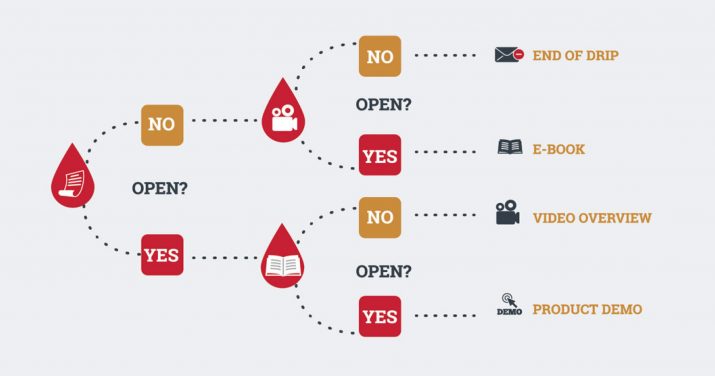
The first step is to segment your database. Once your drip campaign is underway, you’ll need to re-segment based on each user’s response.
Here are some key points to help you understand why database segmentation is so important:
What do you want to achieve with your Digital Marketing strategy?
You need to be clear about your goals and objectives for any lead nurturing campaign within your digital marketing strategy.
Who is your target audience?
Regardless of the market sector you’re targeting, you need to know who your ideal buyer is.
Is your product aimed at B2B or B2C?
Once you answer this, you can determine the type of communication and content you should send.
Now it’s time to create different lists based on your prospects’ content preferences.
B2B – Business to Business
B2C – Business to Consumer
Selling to consumers is very different from selling to businesses—every factor changes depending on your audience.
This approach allows your leads to move up in your funnel automatically and progressively.
Depending on where your customer is in their journey, you’ll need to offer different types of content.
The different stages of the customer journey
A customer might be in the Awareness stage—here, you’ll want to provide content that sparks their interest and delivers value, such as a blog post.
Later, a user may move into the Consideration stage. At this point, sending a guide can be effective, as it not only adds value but also increases engagement. Typically, this is where you offer a solution to a problem they’re facing.
Finally, there’s the Decision stage. Here, it’s time to seal the deal by offering content that helps convince them to choose you.
Once they recognize their problem and see that you have the solution, let your satisfied customers speak for you.
Share success stories—happy clients are your best asset, and your most powerful tool is clear: digital marketing.