#StopRepeatingStories: a digital campaign using artificial intelligence to remind us that antisemitism isn’t just history—it’s happening now
Some digital campaigns barely scratch the surface, while others break through the screen to challenge society directly. #StopRepeatingStories, created by SERVICEPLAN GERMANY / PLAN.NET GERMANY for the Zentralrat der Juden in Deutschland (Central Council of Jews in Germany), is firmly in the latter category. Winner of the iF Design Award 2025 in Communication, Film/Video, this campaign shows how design, film, and artificial intelligence can come together to fight antisemitism through emotion and empathy—without sacrificing a bold, contemporary visual language.
For those of us working in graphic design, branding, web design, and digital campaigns from Barcelona, it’s a clear benchmark for how creativity can become a tool for social responsibility.
Context: an uncomfortable reality that keeps repeating
This campaign was born out of a context as delicate as it is urgent. Eight decades after the Holocaust, Germany is seeing a dramatic spike in antisemitic attacks: daily incidents have jumped from 7 to 29 in just a few months. Yet the public response falls short of the gravity of the situation. Silence, indifference, and a dangerous sense of “this isn’t my problem” prevail. Even when prominent voices in the Jewish community point out parallels with the early days of National Socialism, the public reaction remains lukewarm.
The challenge for the Zentralrat der Juden in Deutschland and the creative team was twofold: first, to show that antisemitism is a current problem, not a closed chapter in history books; and second, to avoid casting Jewish people solely as victims. The question driving the project is direct and powerful: how do you spark genuine empathy in a generation that didn’t live through the Holocaust—without relying on the same old visual tropes?
For a communications agency like ours, specializing in digital marketing campaigns and graphic design in Barcelona, this approach is crucial: it’s not just about delivering a message, but about finding the most honest and effective way to connect with today’s audience.
The creative idea: testimonies that begin in the past and end in the present
The concept behind #StopRepeatingStories is simple to grasp but complex to execute. The campaign centers on three videos that, at first glance, follow the classic format of Holocaust survivor testimonies: elderly people, faces marked by time, calm voices recounting horrors we think we know.
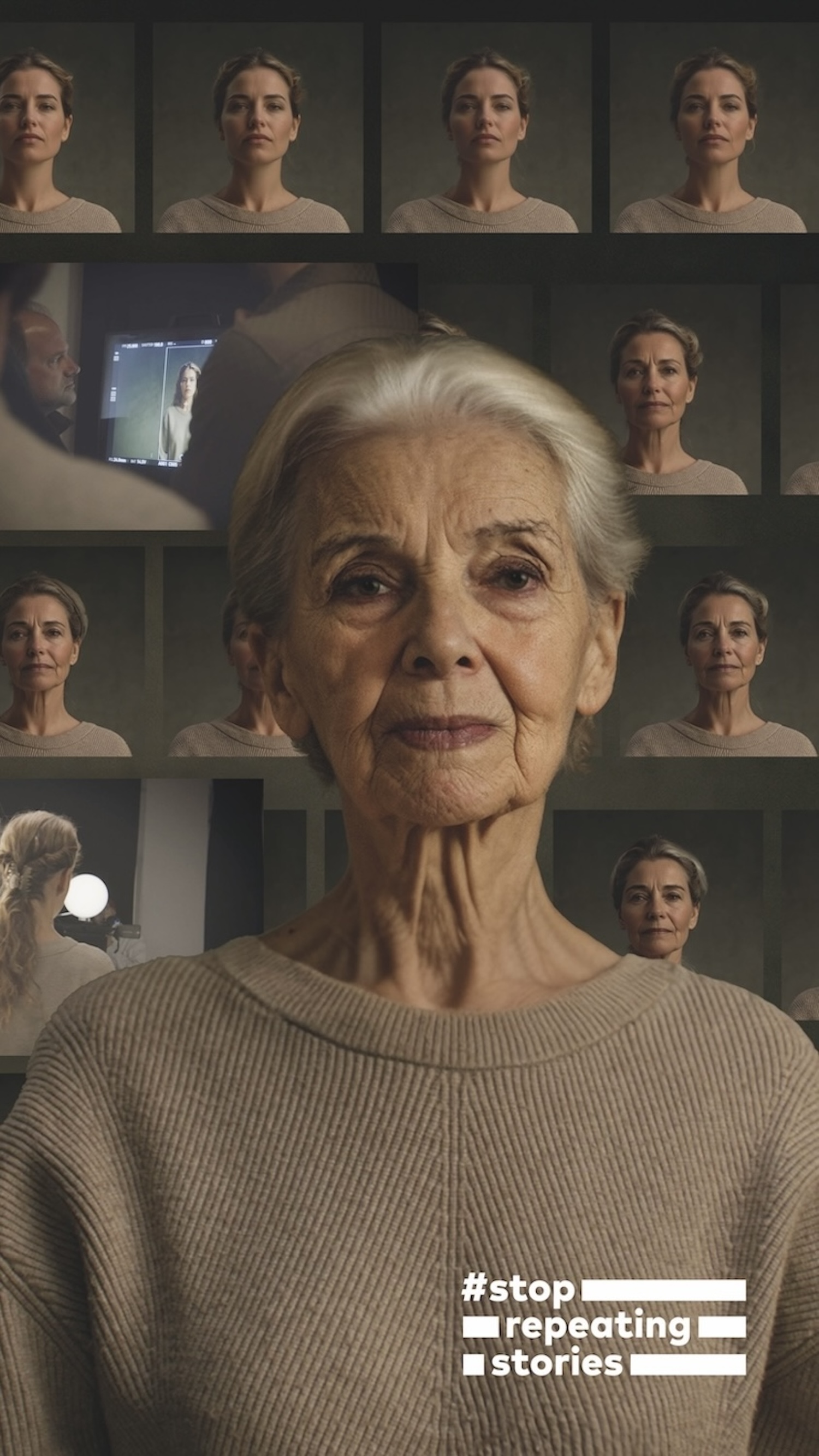
But as the videos progress, something unexpected happens: the protagonists’ faces and voices begin to grow younger, thanks to artificial intelligence. Wrinkles fade, features shift, skin tightens, and their gaze becomes youthful. What starts as a story from the past turns into an uncomfortable revelation: these aren’t 90-year-old survivors, but young people around 20 who could be experiencing these same events today.
The narrative twist is striking: viewers realize they’re not watching a historical reconstruction, but a reflection of the present. That’s the heart of the campaign’s title: “Stop Repeating Stories”. These aren’t distant tales—they’re patterns of hate we risk repeating if we look away.
Technical execution: artificial intelligence in the service of empathy
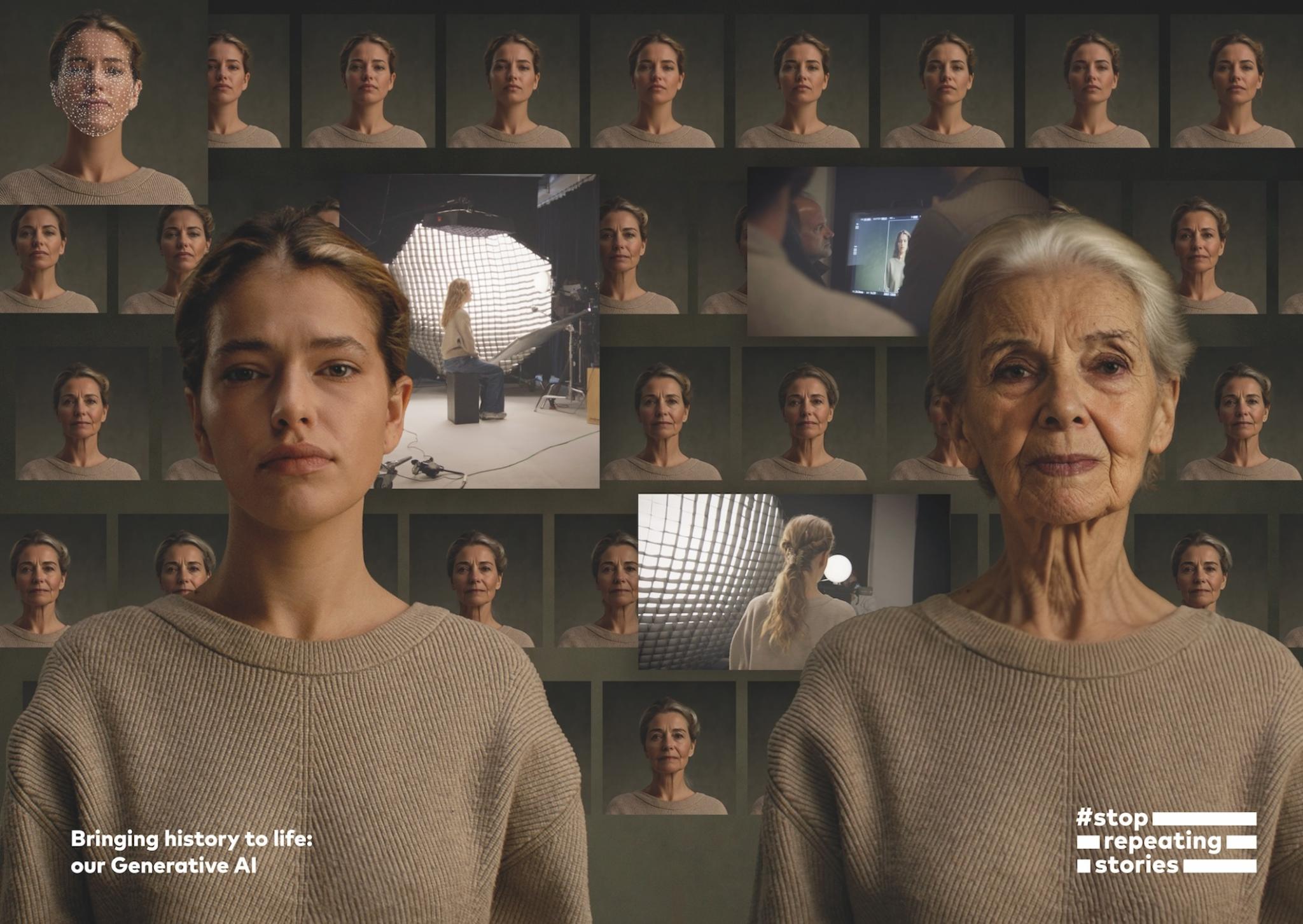
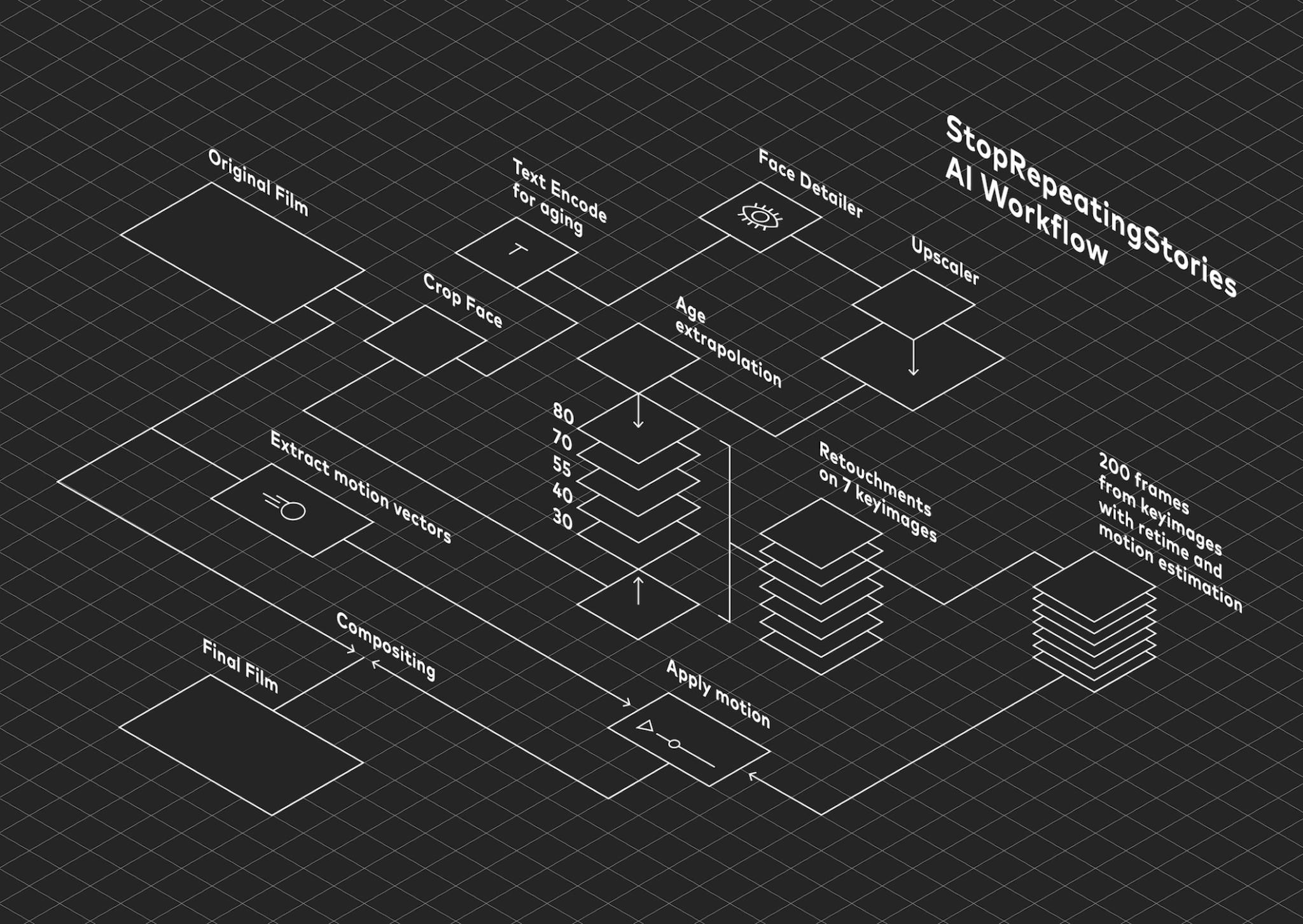
To bring this idea to life, the SERVICEPLAN GERMANY / PLAN.NET GERMANY team developed a hybrid approach, blending traditional filming with cutting-edge technology. First, they filmed young actors—around 20 years old—delivering the testimonies on camera. Then, their proprietary tool, “Gen AI”, along with Retime and motion estimation techniques, was used to generate a sequence of about 200 frames in which the faces age into those of supposed Holocaust survivors.
The process is the reverse of what we usually see in film or advertising: here, youth is transformed into old age, and then that journey is reversed in the final piece. Every detail—skin spots, wrinkles, contours, textures—is carefully crafted to make the transition organic and believable. Artificial intelligence isn’t used as a flashy trick, but as an emotional design tool: what matters isn’t the effect itself, but the sense of vertigo it creates for the viewer.
The soundtrack, an atonal violin piece composed by Not A Machine, heightens the tension and unease without resorting to easy drama. Image and sound build together in a crescendo that ends in an uncomfortable silence, just before the main message becomes clear: “Never again” can’t just be a phrase from the past—it must be a commitment for today.
Visual design: restraint, focus, and respect
Beyond the aging and de-aging effect, the campaign stands out for its restrained, focused visual design. There’s no excess of graphics or unnecessary overlays: the frame centers on the face, the gaze, the voice. This minimalist approach ensures the message takes center stage and avoids turning pain into spectacle.
The color palette is muted and slightly desaturated, evoking historical archives without falling into the black-and-white cliché. Lighting, color grading, and editing reinforce a sense of continuity—past and present seem to merge into a single timeline. It’s an approach that aligns with the best practices in contemporary audiovisual design, where every aesthetic choice serves the concept.
From the perspective of a graphic design and branding agency in Barcelona, this campaign is a perfect example of how mastery of visual language can amplify a social message without resorting to sensationalism. The design doesn’t compete with the story—it supports it.
Digital strategy and reach: from social media to the streets
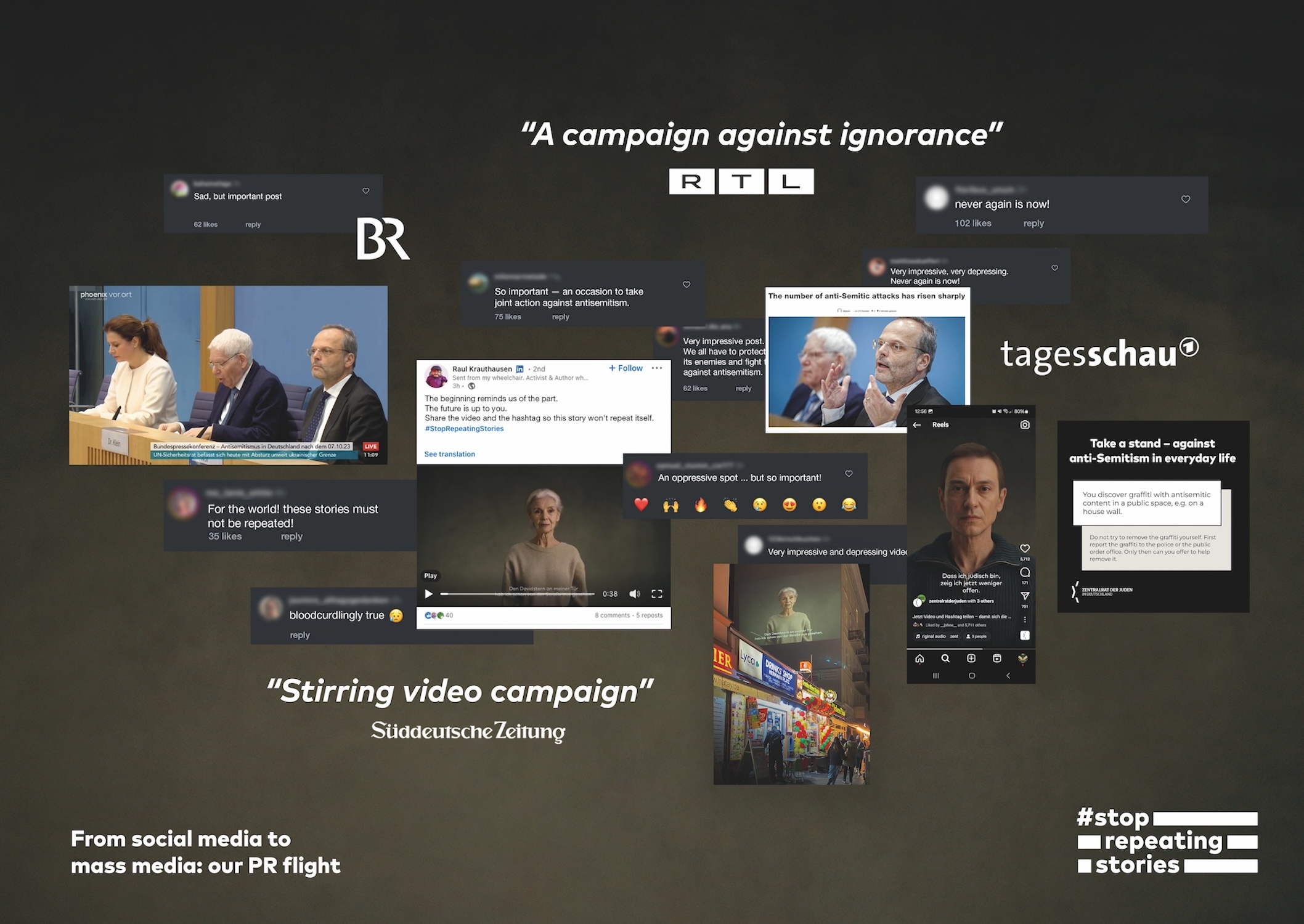
The impact of #StopRepeatingStories isn’t just about creative strength—it’s also the result of a well-orchestrated digital communication strategy. The campaign launched in partnership with the Central Council of Jews in Germany and key influencers like Raul Krauthausen and Culcha Candela, who helped amplify the message across social media.
The results speak for themselves: over 1 million views on social platforms, a 2000% increase in Instagram reach, and 400% growth on LinkedIn. These numbers show that when a story is well-crafted and aligned with a relevant cause, audiences respond.
The campaign was further reinforced with an outdoor installation at Hermannplatz, one of Berlin’s busiest hubs, and a federal-level press conference that brought the issue to mainstream media. This combination of digital strategy, media presence, and public space activation turned the project into a true communication ecosystem—something we also strive for when designing integrated campaigns from our agency in Barcelona.
Microsite and call to action: from emotional impact to everyday action
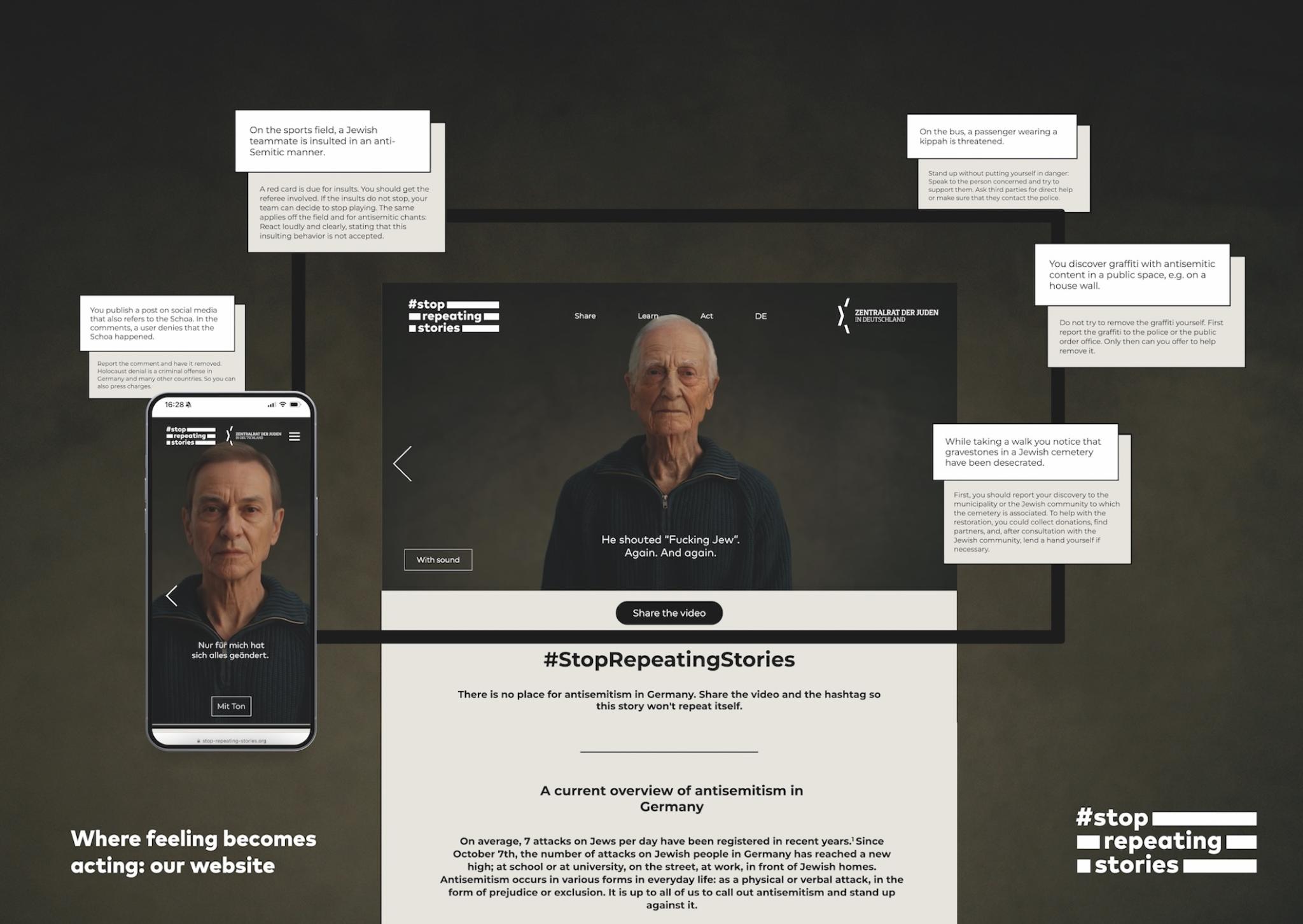
One of the campaign’s greatest strengths is that it doesn’t stop at emotion. The project is rounded out with a dedicated microsite: stop-repeating-stories.org, offering simple, accessible recommendations for taking action against antisemitism in daily life. Tips, shareable resources, downloadable materials, and sharepics turn outrage into concrete, everyday gestures.
This digital dimension makes the campaign a benchmark for those of us working in web design and user experience: the website isn’t just an information hub—it’s an activation platform. Interactive design is harnessed for social change, making it easy for anyone to get involved immediately—by sharing content, learning more, or questioning normalized attitudes.
Impact, legacy, and a lesson in purposeful design
Beyond the metrics, #StopRepeatingStories leaves an important legacy in the field of design with social purpose. The campaign proves that artificial intelligence can be used ethically and responsibly—not to distort reality, but to make it more visible and understandable. Technology doesn’t overshadow the message; it amplifies it.
The project also offers a valuable lesson for agencies and design studios—in Berlin, Barcelona, or anywhere else: when strategy, concept, visual execution, and technology are aligned, the result goes beyond advertising and sparks a social conversation. It’s not just about creating a marketing campaign, but about activating collective awareness.
In a content-saturated world, #StopRepeatingStories reminds us that design still has the power to stop us in our tracks, make us uncomfortable, and make us think. And that, perhaps, is one of communication’s most noble purposes.
Conclusion: when design and technology say “never again”
#StopRepeatingStories is more than an award-winning campaign—it’s an urgent reminder that hatred doesn’t disappear on its own. The work of SERVICEPLAN GERMANY / PLAN.NET GERMANY, in partnership with the Zentralrat der Juden in Deutschland, shows that graphic design, film, branding, and digital communication can be powerful tools against indifference.
As a communications agency specializing in digital campaigns, web design, brand identity, and social media in Barcelona, we see in this project a clear example of where our industry can go: campaigns that seek not just visibility, but responsibility; projects that combine creativity, technology, and ethics to deliver a powerful message: “Never again” isn’t just a slogan from the past—it’s a task for the present.
Credits
Project: #StopRepeatingStories
Client: Zentralrat der Juden in Deutschland K.d.ö.R., Berlin, Germany
Agency / Studio: SERVICEPLAN GERMANY / PLAN.NET GERMANY, Munich, Germany
Production: SERVICEPLAN MAKE
Award: iF Design Award 2025 – Communication, Film/Video
Creative team (selection): A. Schill, T. Diestel, J. Bohné, M. Johne, B. Baum, A. Simon, M. Weinstein, A. Sabbagh, T. Schedler, M. Schöngen, C. Waitzinger, F. Freytag, B. Koch
Production team (selection): A. Nagel, K. Prösel, F. Lotz, T. Nitschke, C. Struber, S. Weidner, J. Rügge, K. Petersen, B. Wolff, F. Baermann
Music composition: Not A Machine
Target region: Europe
Channels: Online film/video, social media, press, outdoor installation, microsite stop-repeating-stories.org