A data-driven idea that turned the future into a tool for social change: how “Sato 2531” transformed an invisible law into an impossible-to-ignore issue
There are communication campaigns that aim for visibility, others for notoriety, and some that achieve something far more complex: changing the perception of a structural issue through a simple, powerful, and strategically built idea. Sato 2531 is one of them. Developed by Dentsu Digital Inc. together with Platinum Inc. and TAIYO KIKAKU Co., Ltd for the organization Asuniwa, this campaign has become a global benchmark for how data-driven creativity can generate social, media, and even political impact.
Recognized with some of the industry’s most prestigious awards — including Clio Awards 2025 (2 Grand Winners and 1 Silver), Best of Public Relations at the ONE Asia Creative Awards, and a D&AD Yellow Pencil — this campaign demonstrates how design, branding, and digital communication can go far beyond aesthetics to become tools for real transformation.
For those of us working in branding, graphic design, communication campaigns, and digital strategy from Barcelona, this project is an essential case study: a campaign where the concept is the true engine, design acts as a language, and data builds a narrative capable of mobilizing an entire society.
Context: a legal tradition that perpetuates inequality
Japan is the only country in the world that legally requires married couples to share the same surname. Although the law is technically neutral, in practice it has a clearly unequal impact: approximately 95% of women adopt their husband’s surname. This rule affects not only personal identity but also professional trajectory, public recognition, and continuity of individual identity.
Despite decades of activism, protests, and legal action, progress has been minimal. Institutional resistance is significant: around 90% of lawmakers in Japan are men, making reform even more difficult in an issue deeply tied to tradition.

Moreover, the problem has a broader social dimension that is not always perceived. Before the campaign, nearly 70% of the population was unaware of the structural impact of this law. What was seen as a cultural norm actually had implications for collective identity, gender equality, and the country’s demographic evolution.
The challenge for Asuniwa was clear: how do you make visible a problem that has been normalized for generations? How do you turn a conversation that has been stagnant for over 40 years into something urgent, relevant, and understandable for society as a whole?
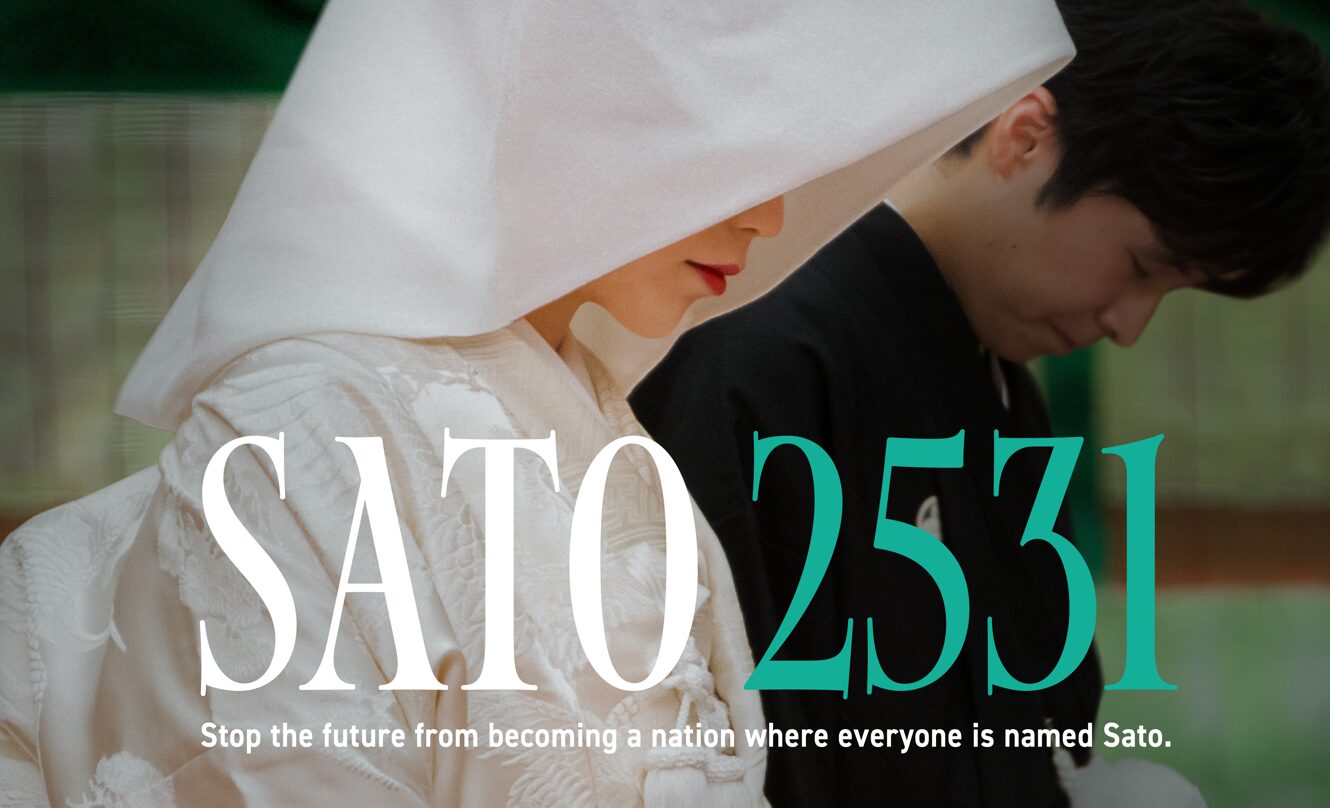
The insight: turning a complex issue into an inevitable consequence
The campaign is built on a key strategic decision: abandoning the traditional emotional narrative and using the power of data to reframe the issue from a completely new perspective.
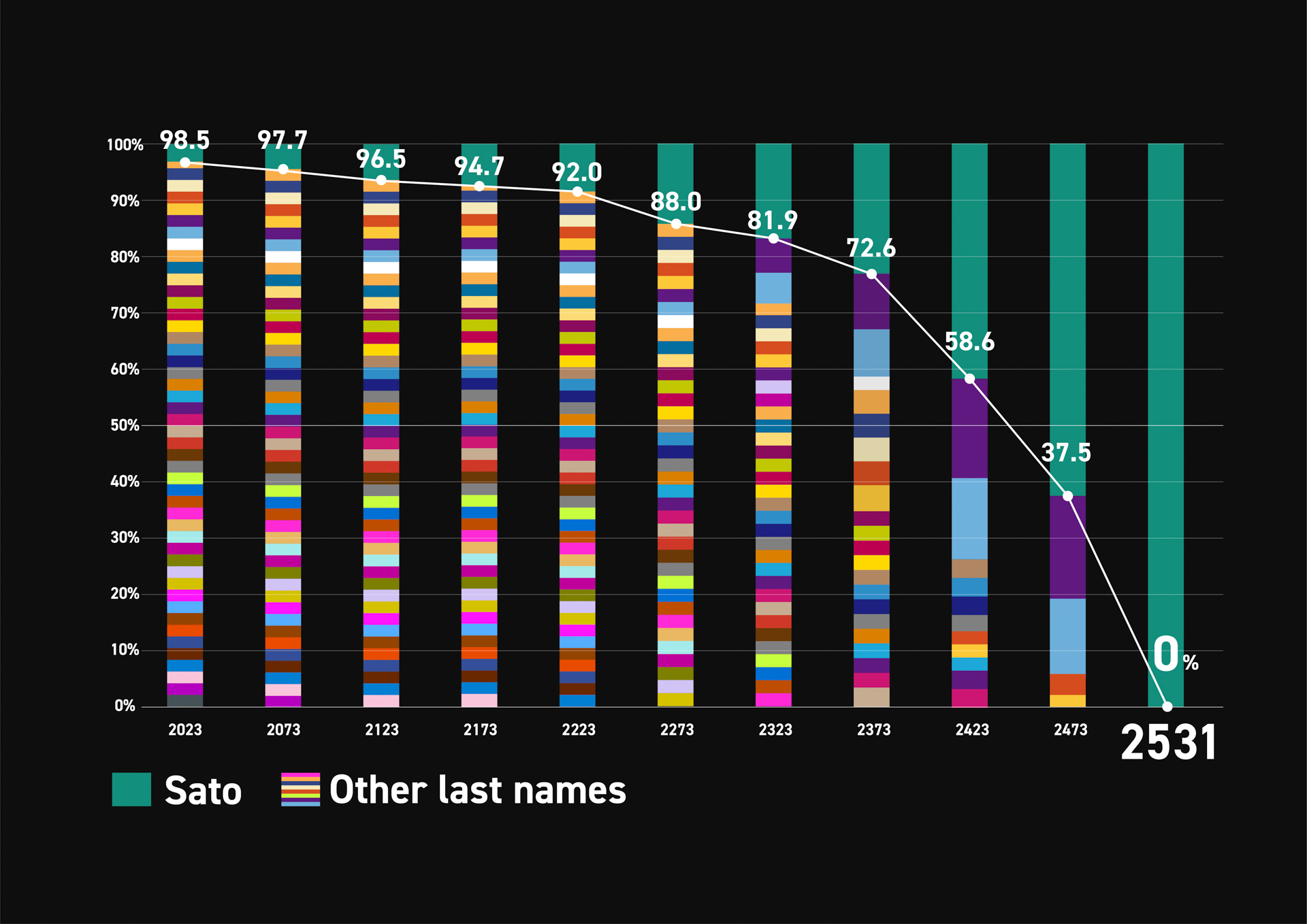
In collaboration with Professor Yoshida, an expert in aging economy and society at Tohoku University, a projection was developed based on real data: surname evolution, birth rates, demographic trends, and social behavior.
The result was a conclusion as simple as it was striking:
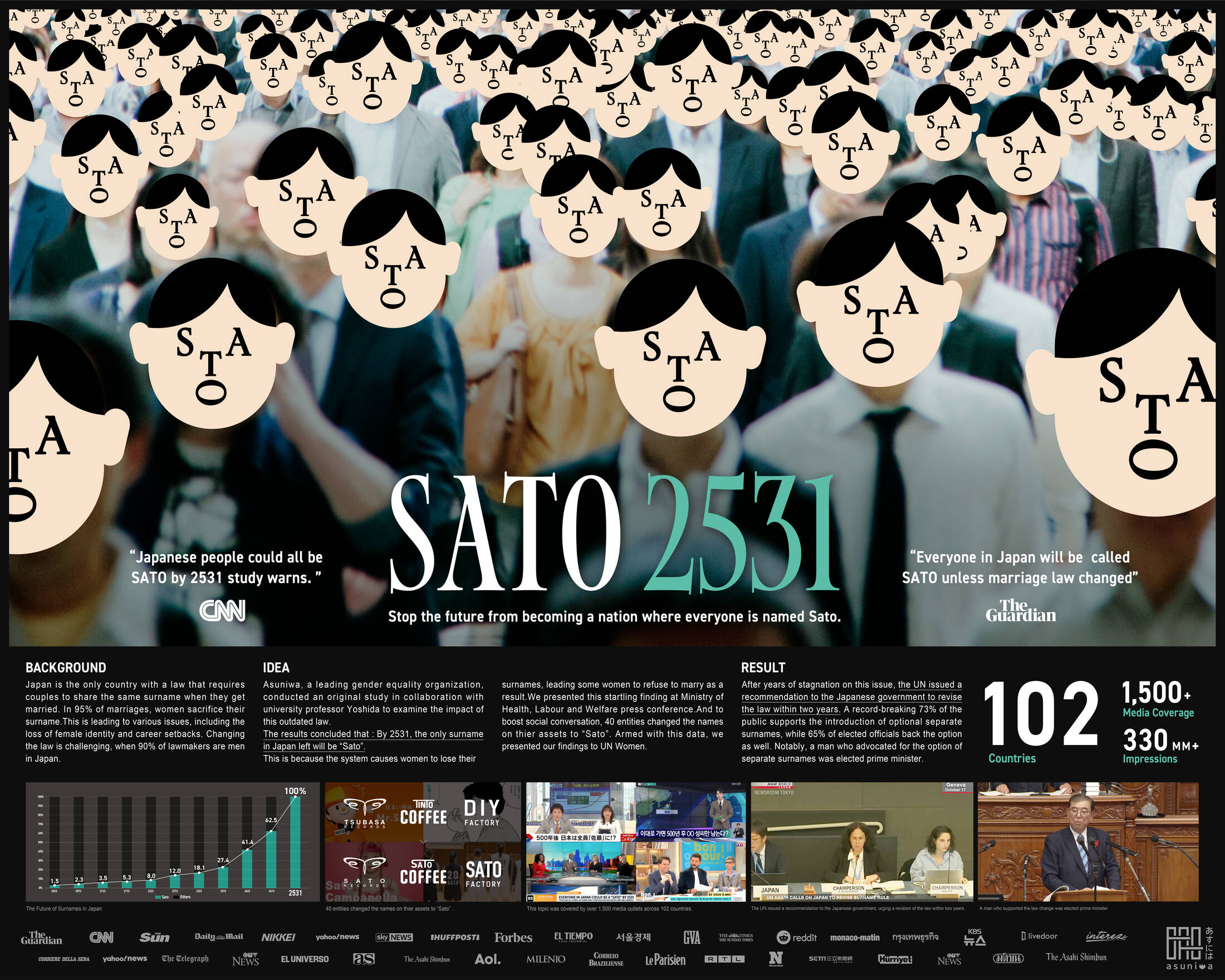
If the law does not change, by the year 2531 everyone in Japan will be called “Sato.”
“Sato” is the most common surname in Japan. This projection transforms a complex legal issue into a clear, almost absurd, yet entirely logical mental image. The campaign achieves something fundamental in communication: making an abstract problem tangible, visual, and, above all, unsettling.
Suddenly, the conversation shifts from being solely a gender issue to becoming a matter of national identity. It is no longer just a women’s issue — it is a problem about the country’s future.
The creative idea: bringing the future into the present
Once the insight was defined, the execution had to match its strength. The campaign chose to make that hypothetical future visible in the present through direct intervention in reality.
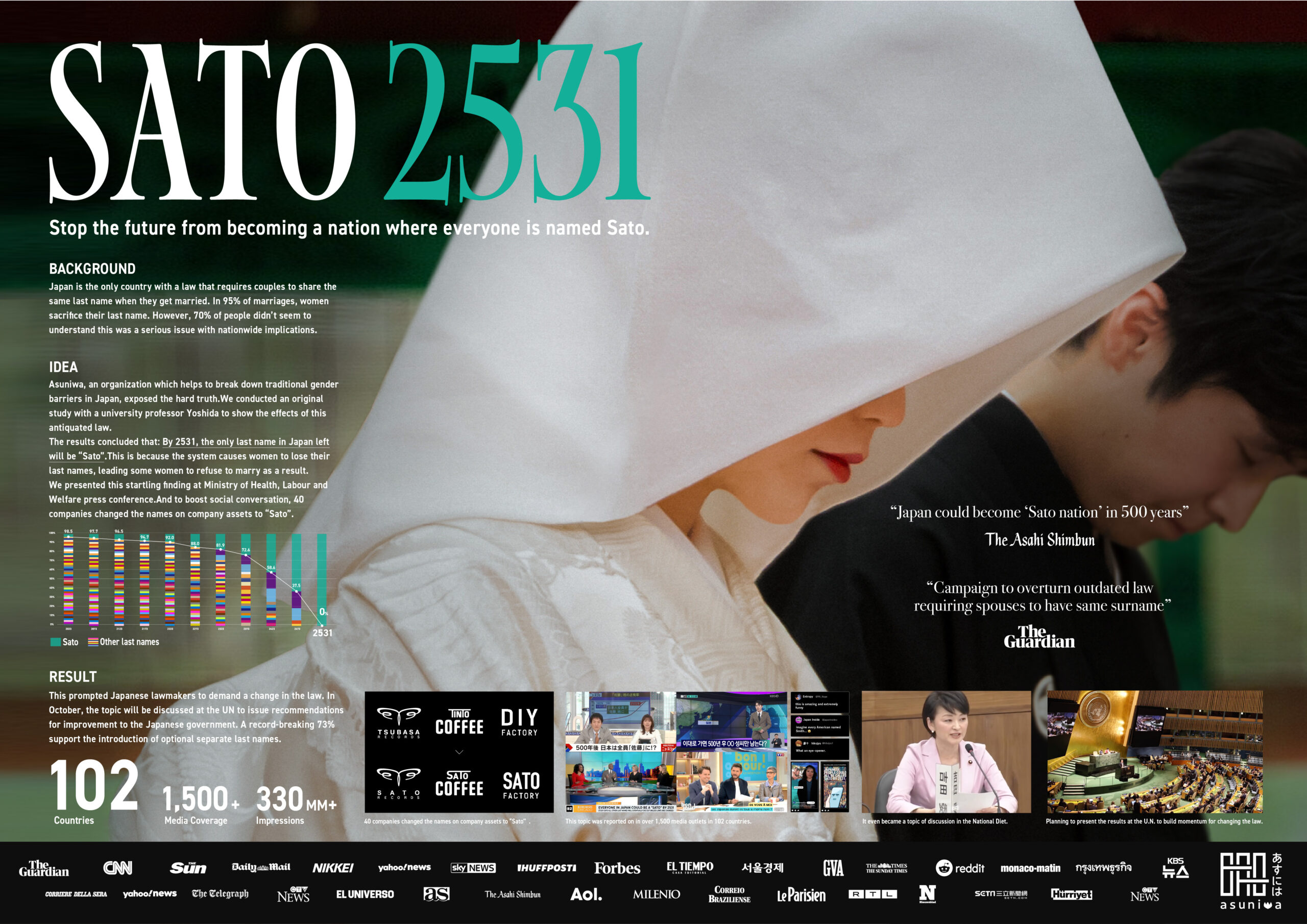
More than 40 companies, brands, artists, sports teams, and public figures adopted the surname “Sato” in their identities. Logos, packaging, stage names, and even sports uniforms were temporarily changed to reflect that future scenario.
This action created immediate disruption. Consumers and citizens began to ask why everything seemed to be called the same. That curiosity became the entry point to the campaign.
The experience was completed with a digital platform explaining the origin of the phenomenon: the current law and its future projection. In this way, the campaign integrated branding, activation, digital content, and communication strategy into a single ecosystem.
Design and branding: when identity becomes the message
One of the most interesting aspects of the project is its use of branding as a communication tool. Instead of creating new complex visual assets, the campaign directly intervenes in existing identities.
The simple act of replacing names with “Sato” generates an immediate sense of uniformity and loss of identity. It is a brilliant example of how graphic design and brand identity can be used to communicate an idea without the need for further explanation.
From the perspective of a design studio in Barcelona, this approach reinforces a key idea: communication does not always mean adding elements — sometimes it is about transforming what already exists to create meaning.
Digital strategy and PR: amplification at a global scale
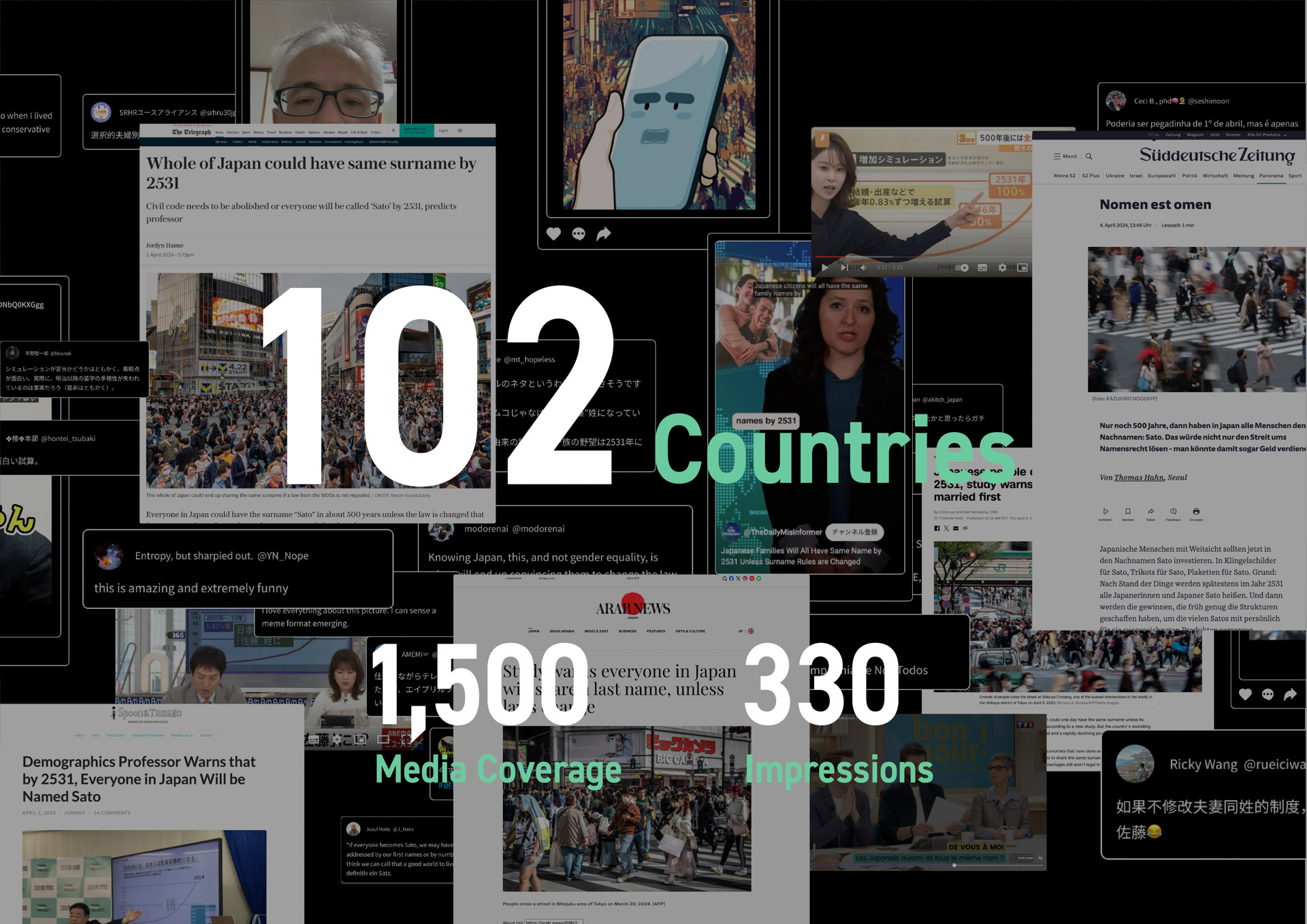
The campaign relied on a highly orchestrated digital communication and public relations strategy. The initial activation sparked conversation across social media, news outlets, and digital platforms, creating a domino effect of organic amplification.
Digital content acted as the explanatory layer, turning curiosity into understanding. This combination of creative action and informative narrative allowed the campaign to scale globally.
The results were striking:
- presence in more than 102 countries,
- over 330 million impressions,
- sustained international media coverage.
The campaign stands as a benchmark in digital communication and PR campaigns, where the concept itself becomes the main driver of reach.

Impact: from public conversation to political agenda
Beyond visibility, the true value of Sato 2531 lies in its real-world impact. The campaign successfully shifted public perception and brought the issue into institutional discussion.
- 73% of the population now supports changing the law.
- 78% of local leaders back the reform.
- The issue was presented to UN Women.
As a result, the United Nations recommended that Japan review the legislation within two years. The campaign also brought the issue into political and parliamentary debate, turning a cultural norm into a matter of public agenda.
This level of impact positions Sato 2531 as an exceptional case where communication not only generates awareness but actively contributes to change.
Conclusion: the power of a well-crafted idea
Sato 2531 demonstrates that the most effective campaigns are not necessarily the most complex, but the clearest. A data-driven idea, a coherent execution, and a well-defined strategy can transform how a society understands a problem.
From our perspective as a branding, design, and communication agency in Barcelona, this project is a powerful reference in strategic creativity. It reminds us that design is not only about form, but also about thinking, context, and the ability to generate impact.
In a world saturated with messages, Sato 2531 stands out for its clarity: a simple idea that turns the future into a warning — and that warning into an opportunity for change.

Credits
Project: Sato 2531
Client: Asuniwa Association / Think Name Project
Agencies: Dentsu Digital Inc., Platinum Inc., TAIYO KIKAKU Co., Ltd
Academic Collaboration: Tohoku University
Country: Japan
Year: 2024–2025
Awards: Clio Awards 2025 (2 Grand, 1 Silver), ONE Asia Creative Awards – Best of Public Relations, D&AD Yellow Pencil