As a business owner or entrepreneur, chances are you’ll need a website to promote your work, products, or services. Continuing with the series we started last month on the process of creating a website, let’s move on to the next key question: “Is what you’re looking for really what you need?”
When you decide to hire a professional for your web development and design, it’s essential to ask yourself if what you want is truly what your business requires. That’s why choosing the right agency or individual for your web development and design project is crucial—they should be able to provide the best possible guidance.
- Should I do it myself, or hire a professional?
- Is what you want really what you need?
- Should your website be self-manageable, or static?
- Will the web development and design be custom-built, or based on a template?
- Have they completed projects similar to what you’re looking for?
- Do you love their portfolio and are you open to their guidance?
- Are you realistic about pricing and development timelines?
- Final thoughts
Is what you want really what you need?
Let’s break down what you might actually be looking for, and try to answer this as clearly as possible in two main points.
Are you aiming for a limited investment?
If so, keep in mind that generally, the more content you want, the higher the website cost will be. Before you start searching for someone to handle your web development and design, ask yourself if you really need all that information on your site—or if you could streamline your content and improve usability and design.
Looking deeper, you have two options: you could create a single template or structure and use it for every section of your website, filling it with generic content; or, you could reduce the amount of content and make each section unique and tailored. This way, you make the user’s visit to your website more engaging—maybe even fun, dynamic, and entertaining.
Our recommendation, of course, is always the second option: carefully curated content supported by strong web design. Naturally, there will be cases where a lot of content is necessary. In those situations, the ideal approach is to find a balance between both options, organizing all sections so that navigation is as intuitive as possible. One thing is certain: user experience comes first, because a bored user is just one click away from closing your tab without a second thought.
Good web design doesn’t have to be expensive
That is, as long as you’ve addressed the previous point properly. Obviously, if you want a lot of content and want it presented in the most attractive way possible, the price will be higher.
Remember, thoughtful web design gives you the opportunity to present information to users in the way and order you want. Plus, with great design you can stand out from your competitors.
Let’s look at one of our recent web development and design projects for a company in the chemical sector.
In this example, we’ll focus on the “About us” section, where we introduce the company.
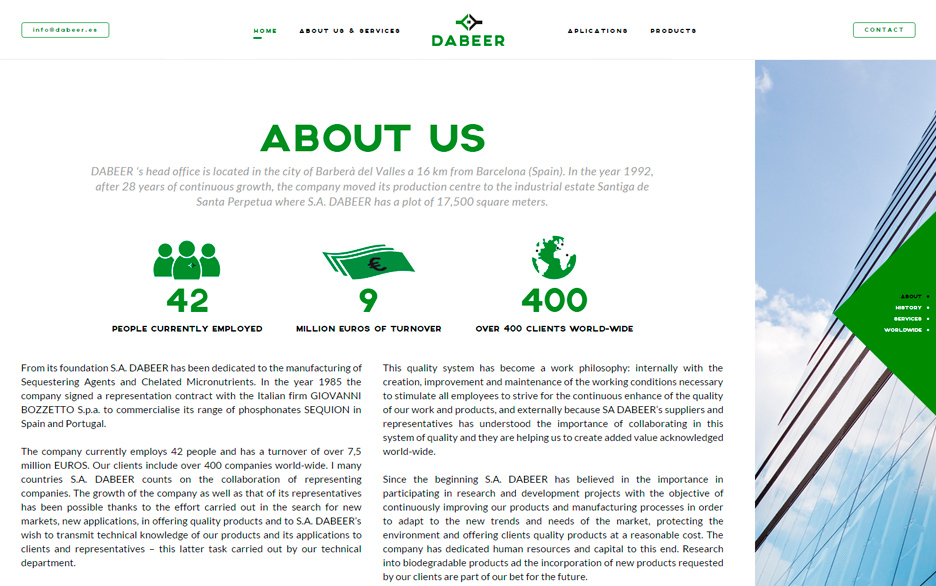
At the top of the section, we include a brief introduction—a summary of the entire section. Combined with the icons and animated figures below, this allows users to quickly grasp all the key information at a glance.
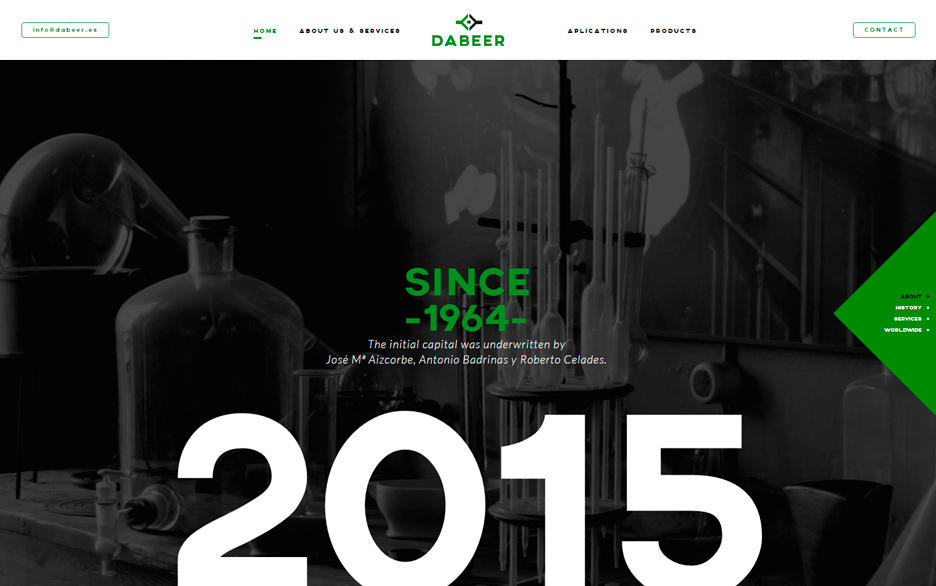
Next, accessible by scrolling or using the right-hand submenu, we present the company’s founding date with an animated effect, adding a touch of “romanticism” for the user.
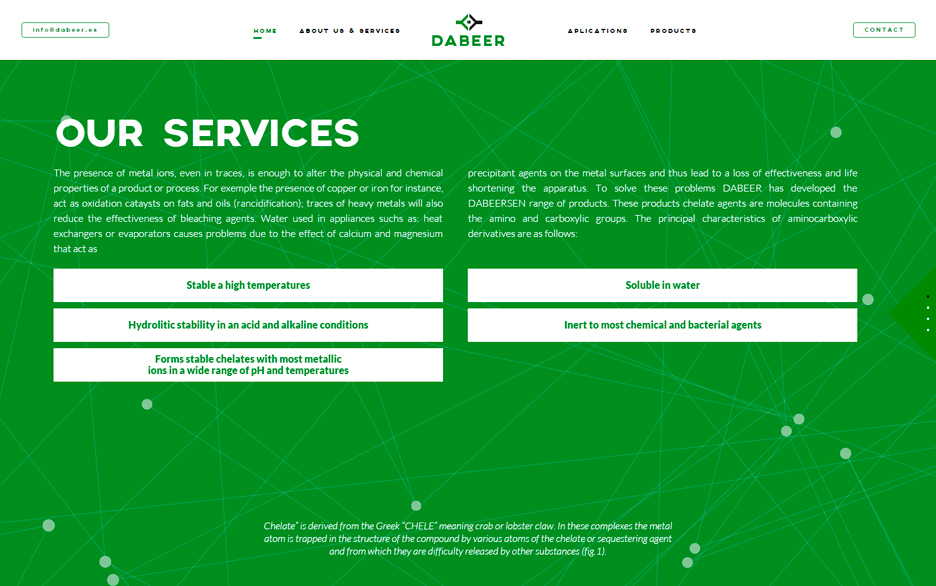
Continuing through the section, we reach services. Here, we provide a short description and summarize the key points. This is set against an animated background simulating a “molecular pattern” that responds to mouse movement. The goal is to keep users engaged, so each new section is a pleasant surprise and encourages them to keep exploring.
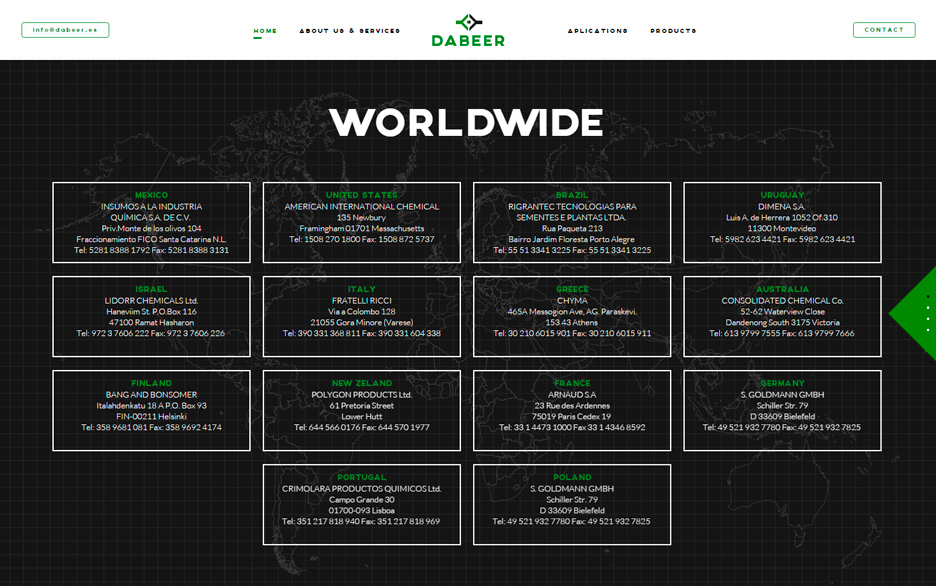
Finally, there’s the “Worldwide” section, where we showcase all the company’s clients. For this, we created an animation where the map and each box appear dynamically.
Click to see the full section live: http://www.dabeer.es/index.php/about-us/
As you can see, the information is far from flat and boring—very few users would stop to read a plain block of text.
In summary
It’s important to analyze your needs or seek expert advice during the web design process, so you can present only the content that’s truly necessary, with maximum usability.
If your goal is to keep your investment modest, in our experience, the best approach is to create a website with just a few sections—for example: home, about, services, and contact. Give each section the same attention, and add new sections as your project grows.
If budget isn’t a concern and you need to present a lot of content, simply put the project in the hands of professionals to ensure it’s structured effectively.
And finally… in the next post in this series, we’ll tackle one of the most important topics—closely related to what we’ve discussed here: Should your website be self-manageable, or static?